
1909 - Already selected for two major exhibitions (BE) in 2026
Asset
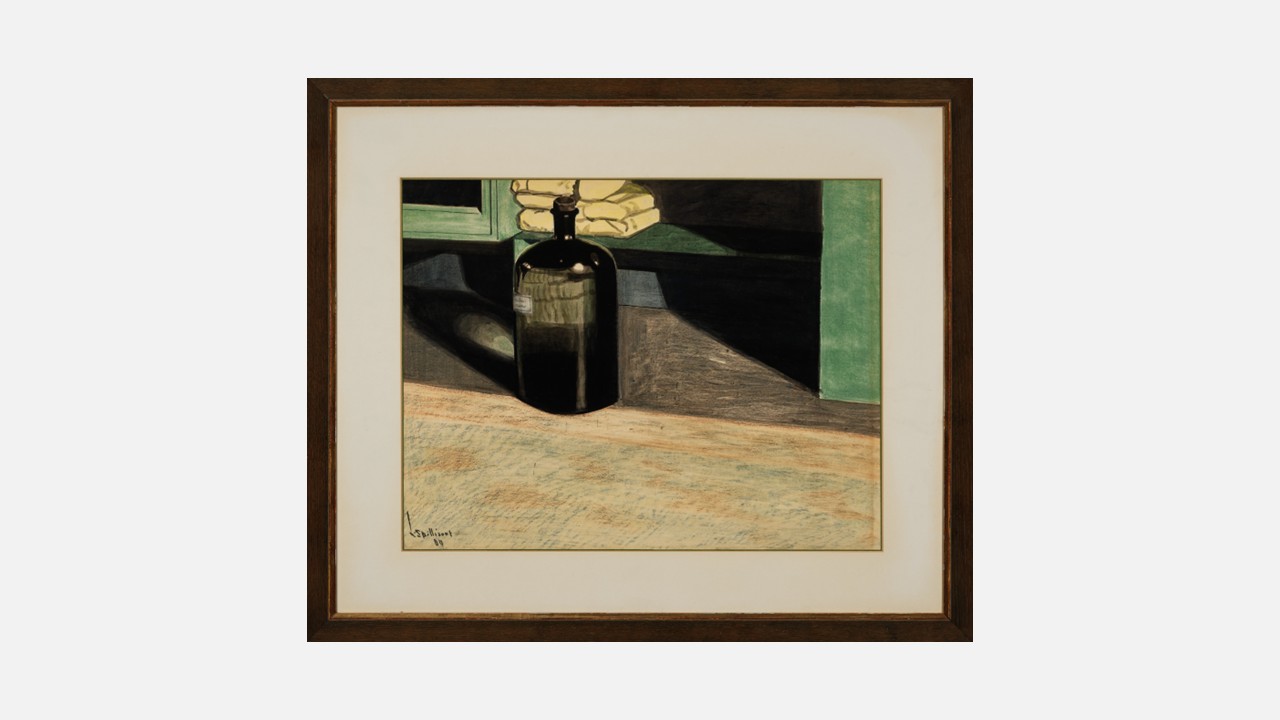
Title: Flask on the Floor (Flacon op de grond), 1909.
Artist: Léon Spilliaert (Ostend, 1881 – Brussels, 1946).
Year: 1909 (Signed and dated 'L. Spilliaert 09' in the lower-left corner).
Medium: Mixed media on paper (Wash India ink, color pencil, pastel, and watercolor).
Dimensions: Approximately 500 x 620 mm.
Rubey Category
Fine Art
Key Fact Highlight
A defining masterwork from Spilliaert’s peak core period (1907–1910), this radical composition transforms a personal biographical memory of his family's Ostend perfumery into a deeply symbolic, modern, and psychologically charged scene that stands as a vital precursor to European avant-garde movements.
Production Year
1909
Condition
Satisfactory condition. Confirmed by independent expert study prior to acquisition.
Provenance
Estate of the artist
Piccadilly Gallery, London (1972)
Private Collection, Cologne
Private Collection, Belgium
Van Herck-Eykelberg Gallery
Genesis
Genesis supported by a preparatory sketch in the permanent collection of the Royal Museums of Fine Arts of Belgium (KMSKB).
Museum Exhibition & Planned Placements
On long-term loan to professional museum institutions and institutional galleries.
Planned partnership duration: 10 years.
Upcoming Exhibition:
Patrick Derom Gallery – Through Half-Open Doors (3 June – 14 August 2026).
Upcoming Exhibition:
Ensorhuis, Ostend (8 October 2026 – 10 January 2027).
Legal Structure
Single Asset Project
Belgian simple partnership named "Rubey Spilliaert Flask on the Floor"
Total Offering Size
€402.500
Total Token Supply
1.000.000 tokens (representing digital partnership units)
Cost Structure
All operational, technical, and structural costs included upfront for the full duration of the partnership.
One-time manager margin of 15% on the acquisition price.
No annual management fees (0%).
No performance or success fees at exit (0%).
Holding Period
Target holding period: 10 years.
Exit window active from year 8 onwards.
Extension option up to a maximum total of 13 years if dictated by market conditions.
Exit Strategy and Liquidity
Primary exit via the sale of the physical artwork through private transaction, specialized art dealer, or international auction house.
Secondary liquidity via peer-to-peer (C2C) trading on the Rubey platform internal marketplace after the primary subscription period closes.
All transfers strictly subject to digital wallet whitelisting and mandatory KYC/AML compliance.
No guarantee that an active secondary market or liquidity will develop.
Investment Ticket Size
Minimum investment: €250 (practically €251,56 due to fixed bundles of 625 units).
Maximum investment: €10.000 (practically €9.810,94 unless exceptionally approved by the manager).
Risk Profile
Single-asset exposure tied entirely to a single physical artwork.
Long-term, illiquid investment horizon.
No guaranteed return; potential for partial or total loss of invested capital.
Target IRR
9–11% net annually under the actively managed models.
Driven by active museum placements, upcoming high-profile exhibitions, provenance enrichment, and the 150th Anniversary catalyst.
Not guaranteed.
Questions
support@rubey.be
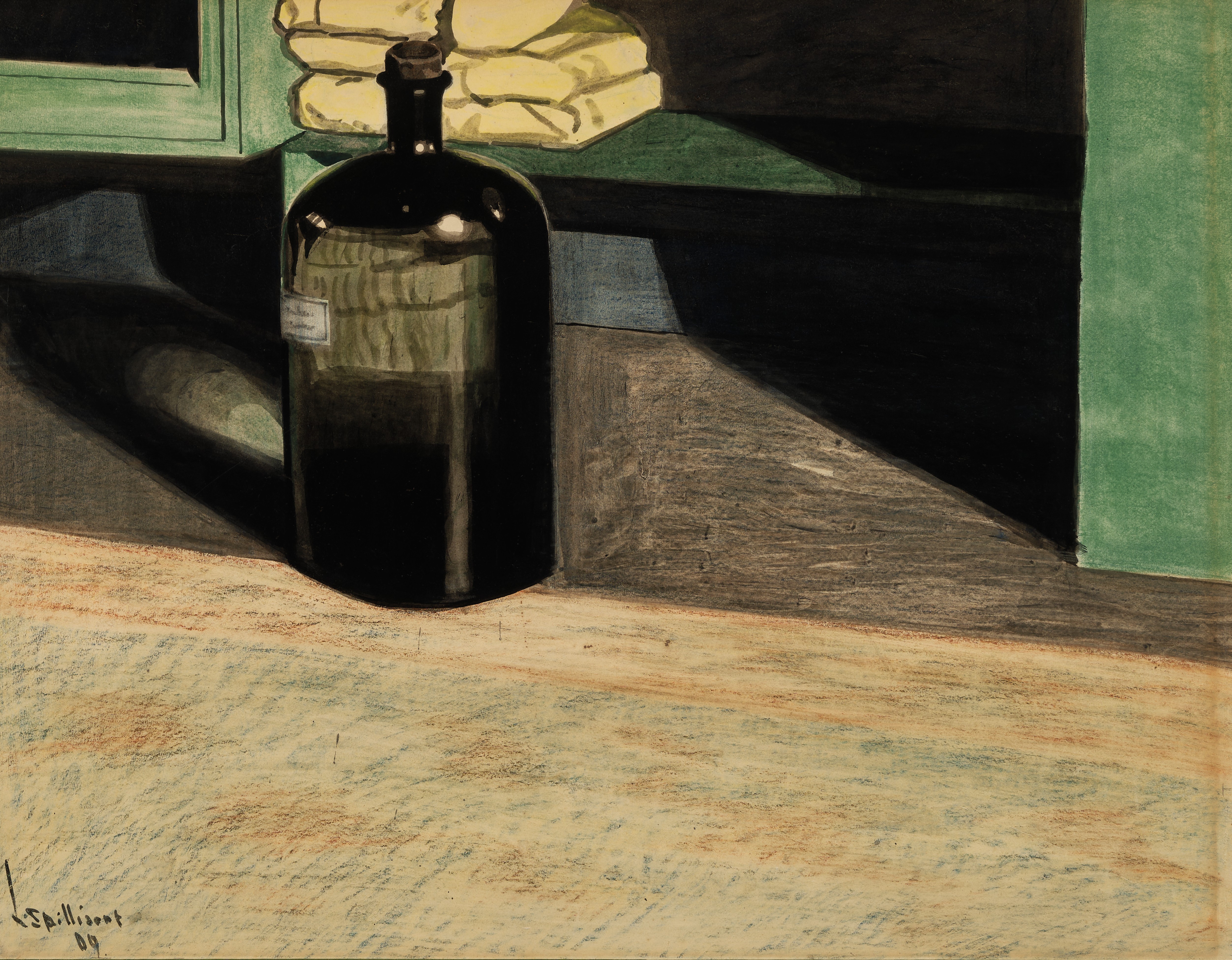
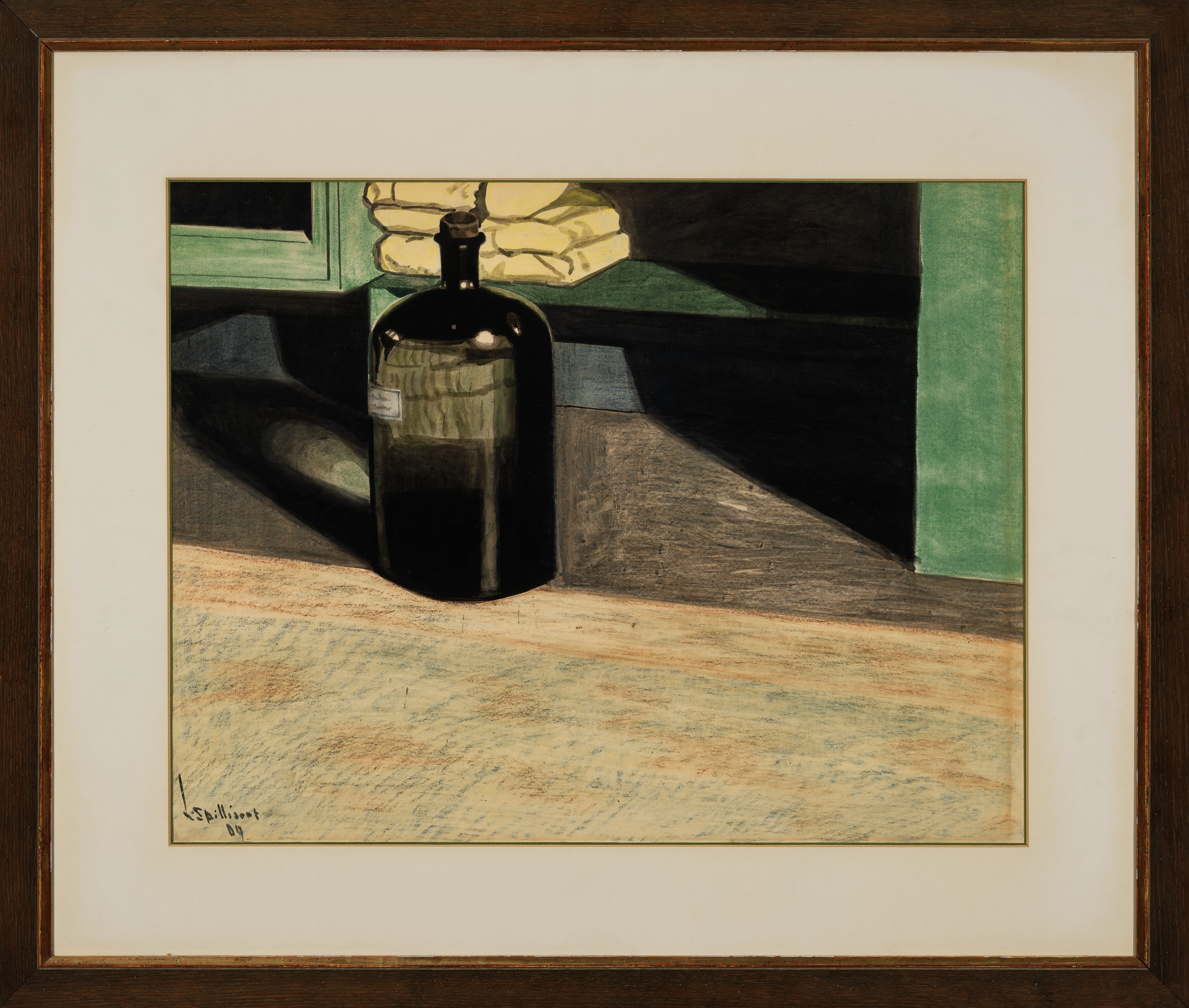

Flask on the Floor (1909) is a defining masterwork by Léon Spilliaert, one of Belgium’s most visionary artists and a pivotal figure in the transition from nineteenth-century Symbolism to modern abstraction. Still life imagery occupies a central place in Spilliaert’s artistic universe. From his early years onward, boxes, flasks, and everyday containers became recurring motifs through which he explored themes of isolation, domestic silence, and the tension between the physical object and mental perception. In Spilliaert’s work, the mundane object never serves as a mere decorative prop; instead, it exposes the anxieties, stillness, and psychological undercurrents of modern existential human behavior.
Painted in 1909, Flask on the Floor belongs to Spilliaert’s highly acclaimed early core period. This phase, widely recognized by art historians as the absolute pinnacle of his career, is marked by a radical freedom and intense stylistic concentration. During these years, Spilliaert approached common subjects with an uncompromising graphic clarity, utilizing deep washes of East-India ink, chalk, and colored pencil to create deep shadows and stark light contrasts. Elements such as radical simplification, deep psychological tension, and a profound sense of alienation, traits that would define much later artistic movements like Surrealism, are fully realized in this work.
The artwork draws direct inspiration from the intimate world of the parental perfumery in Ostend, a city whose atmospheric, wind-swept coastline permanently shaped the artist's inner topography. Yet, Spilliaert’s interpretation is neither documentary nor commercial. Although the title refers explicitly to a flask, the object is completely detached from a shop setting or a laboratory counter.
Instead, the composition is dominated by a single, dark glass bottle placed unexpectedly low on a bare, wide floor. This deliberate, unsettling placement transforms a personal biographical memory into a deeply symbolic and universal scene, completely detached from a specific narrative context. The small, light rectangle on the belly of the bottle, serving as either an ambiguous label or a distorted reflection of a window, gives the flask an uncanny, almost frontal gaze, making it a silent surrogate for human presence.
Art historically, Flask on the Floor occupies a privileged position within a small group of related masterworks on paper. It is intimately linked to the institutional history of the avant-garde, as the exact genesis of this composition is anchored by a direct preparatory design sketch preserved within a sketchpad from 1907–1909 in the permanent collection of the Royal Museums of Fine Arts of Belgium in Brussels (inv. 10.770, p. 21).
The final version distinguishes itself from other early still lifes through its stronger geometric contrasts, its low-angle perspective, and a heightened sense of spatial mystery. Leading contemporary scholars have considered this specific composition vital enough to include and illustrate it in the definitive historical monograph, Spilliaert. De bezielde blik (p. 58), by Dr. Anne Adriaens-Pannier.
Furthermore, the artwork is confirmed to be featured in the highly anticipated publication Léon Spilliaert: Interiors and Still Lifes / La porte entrouverte by Hannibal Books in cooperation with the Patrick Derom Gallery, and is slated for definitive inclusion in the forthcoming Léon Spilliaert catalogue raisonné.
The artwork's historical journey reinforces its cultural significance, boasting a clean, unbroken provenance chain stretching directly from the artist's own estate. In 1972, it passed through the legendary Piccadilly Gallery in London under Mr. Godfrey Pilkington, a key venue for the international promotion of Symbolist art, before entering prestigious private collections in Cologne and Belgium, and eventually being handled by the Van Herck-Eykelberg Gallery.
Today, Flask on the Floor is managed under strict museum-grade conditions of professional conservation, protecting its delicate, light-sensitive mixed media while keeping it at the forefront of global curatorial scholarship. As Spilliaert's practice continues to experience an unprecedented international momentum, fueled by landmark retrospectives at elite global institutions, this work stands as a brilliant testament to his lasting impact on early European modernism. It functions not merely as a historical artifact, but as a masterpiece whose radical forms, silent language, and emotional intensity remain strikingly relevant to modern audiences.
Léon Spilliaert holds a rapidly ascending and increasingly prominent position within the international canon of modern art. He is widely recognized as one of the most visionary Belgian artists of the early twentieth century, serving as a vital, fiercely independent precursor to later modernist, expressionist, and surrealist movements. His highly distinct practice is represented in major museum collections across Europe and North America, including Mu.ZEE, KMSKA, the Royal Museums of Fine Arts of Belgium, the Musée d’Orsay in Paris, and The Metropolitan Museum of Art in New York.
Within the art market, Spilliaert is experiencing an unprecedented surge in global institutional demand alongside an expanding international collector base. Works from his early, concentrated core period, specifically rare, psychologically charged interior scenes and radical still lifes, are exceptionally sought after and form the coveted crown jewels of both museum and private collections.
Public auction data over several decades show that museum-grade works on paper by Léon Spilliaert from his peak years of 1907–1910 demonstrate extraordinary long-term value resilience and compounding appreciation. This is particularly true for rare, complex compositions that combine profound biographical subject matter, explicit dating, and pristine provenance.
Prices for Spilliaert’s premier works have reached significant new heights, as evidenced by verified open market records for top-tier sheets from his core period. Celebrated masterworks such as Phare sur la digue (1908) achieved an exceptional benchmark of €982,800, while La Buveuse d'absinthe (1907) reached €483,000, and Sirène (Baigneuse) (1910) commanded €428,400.
Works officially confirmed for definitive publication by leading scholars and supported by direct preparatory museum sketches achieve significantly higher market confidence and command substantial price premia. While the art market is cyclical, the long-term price trajectory for Spilliaert’s rarest masterpieces remains steeply upward, structurally supported by a severely restricted public supply, as approximately 80% of his total oeuvre remains locked in private hands.
A central element of Rubey’s investment thesis is that institutional recognition, scholarly publication, and public exhibition materially drive value formation in the art market.
This thesis is supported by academic research in cultural economics showing that artworks with a documented exhibition history and museum involvement benefit from significantly reduced information asymmetry and heightened buyer confidence at eventual sale. For Flask on the Floor (1909), this institutional validation is already profoundly robust: the composition’s exact genesis is anchored by a preparatory sketch in a permanent museum collection, namely the Royal Museums of Fine Arts of Belgium. Furthermore, it is featured in definitive historical monographs such as De bezielde blik and is slated for official publication in a major forthcoming book by the foremost authorities on the artist.
Given the immense global attention surrounding Spilliaert's practice, spurred by recent milestone presentations at elite mega-galleries in New York and Paris, and an upcoming touring exhibition to major US museums, there is exceptional institutional interest in this specific work. Rubey is currently assessing multiple competitive requests from prominent museums to determine the optimal strategic alignment for short- or long-term public loans. These upcoming institutional placements will strategically expand the artwork's global footprint, directly enriching its provenance, conservation records, and curatorial documentation prior to exit.
The artwork was acquired at a highly competitive purchase price of €350,000, reflecting a sharp and advantageous entry point for investors. This attractive acquisition value sits significantly below the work's independent appraisal value, which has been formally certified by independent expert prof. em. dr. Johan Swinnen at a central market valuation of €416,250 within a verified expert bandwidth of €388,500 to €444,000.
By bringing the asset to the market at a total offering price of €402,500, investors are granted immediate equity cushioning, as the entry tokenization remains well below the asset's verified valuation. This total offering price includes all upfront structural costs and a one-time margin, ensuring a clean investment vehicle with absolutely no recurring management fees and no performance fees.
The economic outcome of this single-asset project depends entirely on the eventual realized net sale price of the physical artwork at exit, based on a total initial offering size of €402,500 and a standard 10-year holding window.
Unlike passive art investments where assets remain locked away in storage, Rubey applies an active asset management strategy. By securing high-profile international museum loans, maximizing public exposure, and anchoring the artwork in forthcoming definitive publications, Rubey actively drives provenance enrichment and reduces market information asymmetry. This active institutional placement strategy is contractually timed to build a significant curatorial premium leading up to the 150th International Spilliaert Anniversary catalyst, accelerating the compounding appreciation of the asset relative to the passive art market.
Factoring in this active management leverage, Rubey outlines a target net Internal Rate of Return (IRR) range of 9.0% to 11.0% per year for investors under its active management model. This projected performance range breaks down across three speculative growth scenarios:
Passive Market Baseline Scenario: Assuming the artwork merely tracks standard, unmanaged market growth without the compounding lift of institutional exposure, resulting in a hypothetical gross sale price of €525,000 and estimated transaction deductions of €25,000 (net exit proceeds of €500,000). This passive baseline implies a modest annual growth rate of approximately 4.1% on the artwork, yielding a net Internal Rate of Return (IRR) of 2.2% per year for investors.
Target Active Management Scenario: Assuming the successful execution of Rubey's public exposure thesis, where prominent museum loans, documented exhibition history, and elite editorial inclusion generate a verified institutional premium. This yields a target hypothetical gross sale price of €1,045,000. Following estimated auction fees and mandatory transaction taxes of €45,000, the net exit proceeds reach €1,000,000. This actively managed model implies a compounding annual growth rate of approximately 11.6% on the underlying artwork, delivering a target net Internal Rate of Return (IRR) of 9.5% per year for investors. As a historical cross-reference, top-tier masterpieces from Spilliaert’s peak core years have already proven their open market capacity by setting public records up to €982,800 under standard auction conditions.
Optimistic Premium Catalyst Scenario: Assuming maximum institutional acceleration, where competitive global demand from major international collectors is heavily peaked by high-profile touring exhibitions leading up to the 150th Anniversary milestone. This yields an upper-tier hypothetical gross sale price of €1,195,000. Following estimated transaction and exit deductions of €50,000, the net exit proceeds reach €1,145,000. This premium model implies an annual compound growth rate of approximately 13.2% on the artwork, translating into a top-tier net Internal Rate of Return (IRR) of 11.0% per year for investors.
Important warning to the investor: The scenarios and net Internal Rate of Return (IRR) percentages outlined above are purely hypothetical, mathematical models intended solely to illustrate potential market developments. They are based on speculative estimates and historical open market observations and explicitly do not constitute a guarantee, forecast, or promise of future performance or actual returns.
The art market is inherently volatile and influenced by changing collector preferences, macro-economic conditions, and liquidity fluctuations. The partnership provides no capital guarantee whatsoever. There is a very real risk that the final net sale proceeds will be lower than the total value of the outstanding tokens, which could cause investors to lose part or all of their invested capital.
Financial returns are exclusively realized and distributed upon the definitive sale of the physical artwork; no interim distributions or periodic dividends will occur during the lifetime of the partnership. Please review the full FSMA Information Note and the detailed risk factors carefully prior to making any investment decision.
The investment in the artwork Flask on the Floor (1909) by Léon Spilliaert is governed by a robust legal and governance structure designed to protect investors and align economic interests. The binding framework is defined exclusively by the Information Note prepared in accordance with Belgian law and communicated to the FSMA, together with the Partnership Agreement and the statutes of the simple partnership. These documents constitute the sole legally binding framework defining the rights, obligations, risks, and economic interests of investors.
Both the Information Note, the Partnership Agreement, and the Taxation Report are made available in full in this section of the marketplace and can be consulted prior to any investment decision.
This Trust Framework section provides a high-level, non-binding explanation of how the contractual arrangements are implemented in practice. It does not replace, amend, or override the legal documentation.
The project is structured through the Belgian simple partnership (maatschap) named "Rubey Spilliaert Flask on the Floor".
Rubey BV acts as the statutory manager of the partnership and is responsible for executing the project strictly within the parameters defined in the Information Note and the Partnership Agreement. The responsibilities of the manager include:
Administration of the partnership and investor register;
Management of the subscription process and investor onboarding;
Compliance with legal and regulatory requirements (including UBO registration);
Coordination of custody, insurance, maintenance, exhibition, and exit;
Investor communication and reporting.
The partnership operates as a passive holding vehicle. It does not use leverage, does not borrow funds, employs no staff, and does not engage in commercial operations outside the scope defined in the contractual documentation.
To secure the cultural and economic value of the artwork, the partnership places the vehicle on a long-term loan to professional museums or institutional galleries under a formal loan agreement consistent with international museum standards.
Under this arrangement, the exhibiting institutions are strictly responsible for:
Museal-grade custody, climate control, and physical security;
Appropriate conservation and professional display conditions;
Coordination of insurance coverage in line with institutional practice.
The artwork is intended to be displayed on a long-term basis, ensuring public visibility and contributing to cultural heritage, subject to professional oversight by the manager.
The artwork was sourced from a professional art dealer to ensure clean documentation and undeniable provenance.
To guarantee structural transparency before the launch of the project, independent professional expert assessments were obtained to establish the artwork's physical condition, authenticity, and fair market value. These findings are detailed in the Taxation Report.
Key safeguards defined in the Partnership Agreement and Information Note include:
Single-Asset Protection: A strict single-asset structure with no possibility of asset substitution, reinvestment, or operational expansion;
Debt Prohibition: Absolute prohibition of external leverage, financial liabilities, or operational indebtedness;
Pro Rata Liquidation: Contractually guaranteed pro rata participation of investors in the net sale proceeds upon liquidation;
Defined Separation of Rights: Investors acquire clean contractual and economic co-ownership interests. They do not acquire usage, physical possession, or individual management rights over the artwork, shielding the asset from individual investor interference.
Ownership interests in the partnership are digitally represented through security tokens utilizing the ERC-3643 standard. These tokens serve as a modern technical tool to facilitate fractional ownership representation and do not replace the underlying legal structure.
Security and compliance safeguards include:
Whitelisted Ecosystem: Mandatory KYC (Know Your Customer) and AML (Anti-Money Laundering) verification for all participants; transfers are technically restricted to validated wallets;
Decisive Legal Register: In accordance with the Belgian Civil Code, the legally decisive record of ownership is the off-chain partnership register maintained by Rubey. In case of any technical discrepancy, the offline partnership register prevails over any on-chain record;
Ordered Phases: Technical transfer restrictions are automatically enforced via smart contracts during critical operational windows, such as the initial subscription phase and the final liquidation phase.
The partnership is structured to avoid ongoing friction costs and fully align the interests of the manager with the investors:
Upfront Remuneration: Rubey’s remuneration is fixed upfront through a one-time offering margin included in the initial token price;
No Ongoing Cost Friction: No recurring annual management fees are charged to investors; all ongoing operational costs (insurance, platform maintenance, administration) are covered by the manager;
Performance Neutrality: No success fees apply at exit; the financial outcome for both parties depends solely on the realized net sale value of the asset.
In accordance with the contractual documentation, the statutory manager provides ongoing transparency via:
Periodic updates regarding the condition and exhibition status of the artwork;
Access to updated valuation information when formal appraisals occur;
Advance communication prior to executing a contemplated sale process;
Full transparency on final costs and proceeds during the liquidation phase.
This investment relates to a single, historically significant artwork, Flask on the Floor (1909) by Léon Spilliaert, and is structured as a Single Asset Project through the Belgian simple partnership (maatschap) Rubey Spilliaert Flask on the Floor.
Investors participate by subscribing to digital partnership units (represented by security tokens) that grant a pro rata economic co-ownership interest in the underlying asset, in strict accordance with the FSMA Information Note and the Partnership Agreement.
Legal Vehicle: Belgian simple partnership (maatschap / société simple) without legal personality.
Underlying Asset: One single, physical artwork, Flask on the Floor by Léon Spilliaert, painted in 1909.
Statutory Manager: Rubey BV (registered in Mortsel, Belgium), responsible for all operations without annual management fees.
Governing Law: Belgian Law.
Asset Status: Unencumbered, single-asset structure with no debt, no leverage, and a total prohibition on external financing.
Total Offering Size (Hard Cap): €402.500.
Minimum Fundraising Threshold (Soft Cap): 75% of the total offering (€301.875).
Note: If the soft cap is not reached by the end of the subscription period, the offering is cancelled and all contributions are refunded to the original payment account, minus the processing costs charged by the payment service provider (Stripe).
Subscription Period: From 15 June 2026 until 14 June 2027 (12 months), subject to early closing if the hard cap is reached.
Investor Eligibility: Open to investors who successfully clear the mandatory digital KYC (Know Your Customer) and AML (Anti-Money Laundering) verification.
Minimum Initial Investment: €250.
Technical implementation: Subscribed in fixed bundles of 625 partnership units, resulting in a practical minimum entry of €251,56.
Maximum Investment Limit: €10.000 per individual investor, unless exceptional written approval is granted by the statutory manager.
Technical implementation: Restricted to a maximum of 24.375 units, resulting in a practical maximum entry of €9.810,94.
Acquisition Price of the Artwork: €350.000 (established via independent expert appraisal).
Manager Issuance Margin: A one-time margin of 15% of the acquisition price (€52.500), fully included in the initial offering amount.
Included Operational Costs: The initial offering price covers all costs for the entire (maximum 13-year) duration of the partnership. Investors will never face out-of-pocket expenses or capital calls for:
Corporate structuring and legal onboarding;
Compliance oversight and ongoing AML auditing;
Tokenisation infrastructure, smart contract deployment, and platform maintenance;
Insurance coordination and regulatory reporting;
Long-term asset management and ultimate exit coordination.
Ongoing Management Fees: None (0% annual management fees).
Performance or Success Fees: None (0% success fees at exit).
Planned Holding Period: 10 years from the close of the offering.
Contractual Exit Window: The asset may be brought to market from year 8 onwards.
Extension Option: The statutory manager retains the right to extend the holding period by up to 3 additional blocks of 1 year (maximum total duration of 13 years) if prevailing art market conditions dictate.
Exit Strategy: Sale of the physical artwork via private treaty transaction, specialized international art dealer, or a major international auction house. The timing, method, and channel of sale are determined exclusively by the statutory manager based on independent appraisals.
Distribution of Exit Proceeds: Net sale proceeds (defined strictly as the gross sale price minus mandatory third-party auction fees or legally required transaction taxes) are distributed 100% pro rata to tokenholders based on the decisive investor register.
Note: There is no contractual guarantee that a sale will occur at a specific time or at a target price.
Primary Subscription Phase: During the active offering period, partnership units are locked and completely non-transferable.
Secondary Market Phase: After the successful closing of the offering, partnership units can be exchanged between validated users via Rubey's internal peer-to-peer (C2C) bulletin board marketplace.
Transfer Compliance: All secondary transfers require both the buyer and seller to hold fully whitelisted, KYC/AML-compliant digital wallets.
Exit Phase Freeze: Transfers are automatically and completely blocked upon the official commencement of the divestment and liquidation phase to ensure an orderly pro rata payout.
Liquidity Risk Warning: No guarantee is provided that an active or highly liquid secondary market will develop; investors should view this as a long-term alternative investment.